Some years ago, I got the project to set up a fish processing operation in Klemtu on the central coast of British Columbia. Some agreement had been made a couple of years earlier, as the whole project started with the set up of fish farms.
For the processing, we needed to not only equip the plant, but also train the staff of this small coastal community isolated on an island with no road connection to the mainland. Therefore, the logistics were quite adverse: an isolated island with about no choice of carriers except the one that had been appointed on a sea that is often dangerous to the point that barges do not even venture on it. The risk was that the fresh fish could be stuck and not be delivered on time. Of course, that would have been unacceptable for our customers, who were located thousands of km away.
When it came to the facilities, the local community was providing for the plant, meaning a very basic building with no specific equipment for salmon processing. In the plant’s yard we had to browse through a pile of old tables and pipes to figure out something. Since volumes were starting rather low, it would not have been sensible to buy automated processing equipment, because the cost per pound of fish would have been horrendous. Further, the isolation of the place would have made any call for a technician about useless, as it would have taken him a couple of days to be on the premises. All the work was to be manual.
The equipment was probably the easiest part, though. We needed to train the staff to modern food production and educate them about to all aspects of food safety and quality, as they had never been exposed to this. Everyone who has dealt with First Nations knows that they are dealing with a number of social issues and poor physical health and condition, unfortunately the result of past colonization and the destruction of their traditional society. As such, this exercise was a great way of merging two worlds and recreating a feeling of community between this village and the international food business including large retailers and food service companies in the US and Canada.
We developed the training program covering all theoretical aspects as well as the practical realities of fish processing. A few chosen crew members were sent to an experienced fish plant to get exposure to modern processing. We set up an exam to have an incentive for the potential employees to study our material. As it appeared the day of the exam, half of the students did not show up and someone explained to me that some felt uncomfortable with writing. Of course, this was an awkward situation and there was a chance of losing some of the workforce, which is not good when that workforce is already limited, and replacement not easy to find. I turned this around by giving only one collective grade. After all, I had repeated so many times that this would be teamwork, what better example could I find to illustrate that than giving the team the grade, instead of individual marks?
Considering how important it is to gut and cut the fish properly, I was more interested in the quality of the work than the productivity at first. Once they would master the technique, we could think of increasing the pace of the processing line. So, we started with the equivalent of half a truck the first day, and the second half for the following day. In a normal plant, a full truck was processed in five hours in those days. I was expecting that our first half load would be done in eight hours at most. The reality came out quite differently. After two hours, the staff got physically tired and I could notice that moment when all the shoulders started to drop. After eight hours, many of the workers went back home because they were tired. We finished the first production day in thirteen hours! The second day was even worse with some people not showing up at all, and it took 23 hours! The situation looked lost. However, my sense of persistence made me refuse to give up so quickly. I re-planned the next round of harvests to be only a third of a truck per processing day. This was the magical number, and from there, our staff was able to work within normal hours, and get more productive, while producing the proper quality. Within two weeks after this, they were able to process a full truck in 9 hours! What a turn-around! As production volumes were increasing, we were able to justify for the purchase of machines to help speeding up the operation and by then we were able to process fish as quickly as any other regular plant.
As time went by, some of the locals showed capacities to take charge of more and more things, and even the original agreement was clearly that management activities had to be carried out by non-locals, we created several positions that they could fill successfully.
Yet, beyond the business case, the most valuable experience for me had been to see activity coming back in a community plagued by 80% unemployment before this project started. Getting work did not only give them money, but it helped them become healthier, with many of the employees recovering from diabetes. The most important of all was a boosted self-esteem, as they found a new purpose in their lives.
They felt successful, happy and fulfilled again!
Copyright 2009 The Happy Future Group Consulting Ltd.


 Posted by Christophe Pelletier
 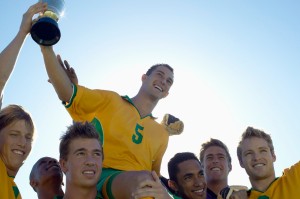 In sports, everybody knows the importance of having a group of talented people who can play together harmoniously for the interest of the group. Not only must the team members be good at their specialty, but they also must have the understanding of the other players’ needs and skills, so that they can create for them opportunities to score. Moreover, everybody understands in sports the crucial role of the coach to create the proper interaction to achieve success. Terms as goals, help and support are common.
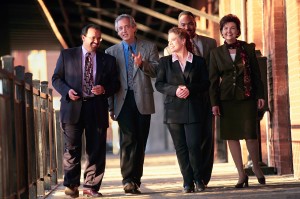 So, how to achieve superior performance and build cohesive teams across departments? Actually, it is rather simple, at least in theory. Just copy what they do in sports. They draw charts about the strategy to reach the goal and beat the opponent. They review it together, and everybody gets to hear what their specific role is going to be. They will have to pay attention to what the adversary’s moves are and they will develop alternative strategies to deal with them. Everyone in the team knows their function, and most importantly, they know what their fellow team members will do for them and what they expect from them. Further, the coach is present on the sidelines and is very vocal giving instructions at once all the time as the game develops. Unfortunately, such a presence and such a hands-on support are often missing in business, because the coach is in a meeting.
 Yet, a satisfied and happy boss is very important for an organization, because the boss’s personality and mood is quite contagious. You can be sure that a bitter boss means lots of bitterness and tension on the work floor. Therefore, a happy boss is an absolute necessity in order for a company to achieve superior performance.
 A famous example of presence for a leader is the battle of the bridge of Arcola. Napoleon was still a young general and the battle against the Austrians was not going too well. The story is that Napoleon took the flag and led his troops marching on the bridge, dodging bullets. This reportedly boosted his army’s spirits; they followed him on the bridge for the direct confrontation with the enemy. The result was a strategic victory. Even though this story seems to have been embellished, as Napoleon might not have acted as heroically as the story states, it certainly has established his leadership position and it created a strong mystique about his persona.
 Empathy is one of those qualities that is acknowledged as being important, but for which there is little training given. One reason probably is that empathy, like some other personality traits, one is born with it more than one can learn it. Yet, there are certain patterns that can be acquired and help people interact with their fellow men better.
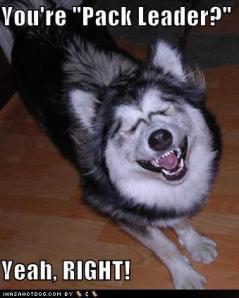 So, let’s forget the resume, as it not giving me the right information and let’s try to see if a personality test would work better. In my doggy world, we establish who the leader of the pack is in a very simple and primal way: the more dominant one leads. Could it be any simpler than that? Although we need to take a slightly different approach with people, establishing a relationship dog-boss follow a rather similar process. We will accept you as the boss only if you are able to earn our respect. Look around and you will see all those dog owners who failed to get to that point: they simply do not have us under control. We run away, we pull in a different direction than the one they want us to go to, or we are aggressive. In short, we behave badly. Well, that is from the boss’s perspective. For us there is another truth: we behave that way because we have no boss. There is no one we respect enough to follow, so we set our own course. Does that sound familiar to you humans? Interesting, isn’t it? We do not have the ability to do politics; neither do we have any awareness of our pedigree. Therefore, respect is about all we have. Also, remember that you do not spell respect F-E-A-R. If you lead us by fear, we probably follow because we prefer to avoid the consequences, but we will not like you, we will not respect you, and when the time is right, we will turn against you; unless we just become dysfunctional and neurotic, as I have sometimes seen.

 Secondly, just observe the people. In the great places to work for, people exude happiness. They will smile at you in the corridors and they will say hello. Beware of the workplaces where you will not even get eye contact, forget about a smile.
 This is just an example of how important presence and availability are in managing people. If you have done your hiring properly and brought in the right people in the right jobs, they will understand very quickly how to do what is expected from them and deliver the performance that meets, and in most cases exceeds the targets. The role of the manager in such a situation is a little comparable with a shepherd. You keep a good oversight of your troops, but if any one wanders in the wrong direction, you just bring him/her back on the right track.
![j0414117[1]](https://happyfuturegroup.com/wp-content/uploads/2009/05/j04141171.jpg?w=197&h=300 "Watch Them Soar!") To illustrate this, I cannot think of a better example than one of my employees when I was in the aquaculture business.
To illustrate this, I cannot think of a better example than one of my employees when I was in the aquaculture business.




 The Happy Future Group